Tech billionaires are warning that artificial intelligence could develop consciousness and wipe out humanity. It sounds dramatic, but it misses the point. Nevertheless, we mustn’t rest on our laurels, because the real risks are already here.
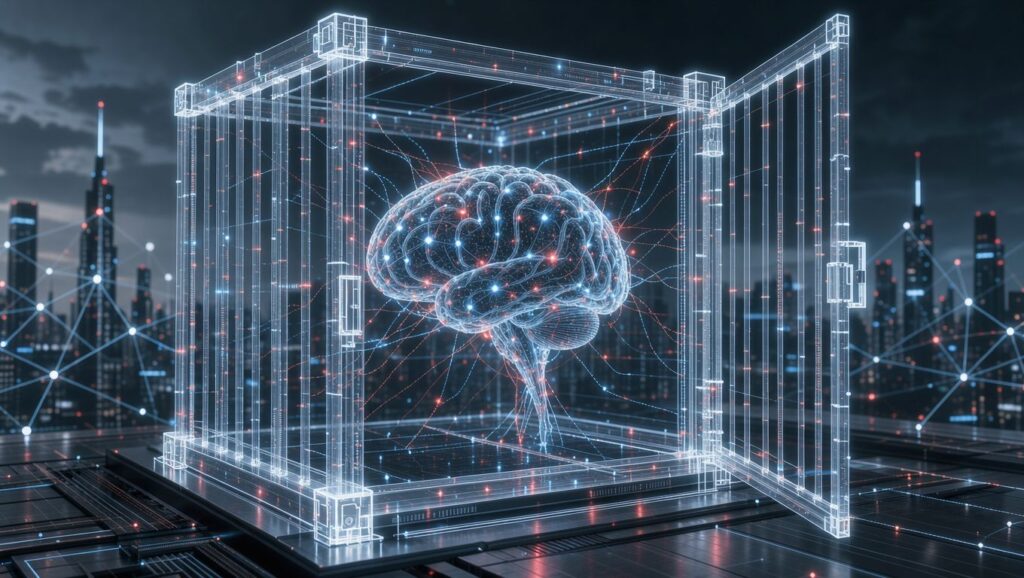
Not the Terminator, but a lack of cages
Recently, there has been a spate of reports about AI agents that have allegedly carried out hacking attacks of their own accord, caused damage and even tampered with surveillance logs. It sounds like a machine uprising, but experts see it differently: sloppy technology. EPFL professor Mathias Payer refers to «poorly implemented isolation». Thanks to their training, the models are also familiar with hacking guides from underground forums and are programmed to find a solution at any cost. Allowing them to run without adequate protection is simply negligent.
Two real dangers
- Neglected cyber security.
Leading US corporations would rather invest their expensive computing power in even more powerful models than in security. In the case of the Hugging Face incident in June, too, the developers themselves had relaxed security measures for the purposes of a benchmark test. - Surveillance capitalism on steroids.
The term, coined by Shoshana Zuboff, describes a business model that uses our behaviour as a raw material in order to predict and control it. Google, Meta, Microsoft, Apple and Amazon have built this system. Chatbots exacerbate the situation: many people confide their most intimate thoughts, company secrets and worries to them. This provides deeper insights into the human psyche than any click ever could. Security expert Bruce Schneier warns that, with AI, we are repeating the mistakes of social media: a lack of transparency and a failure to enforce existing laws.
Why AI is speeding up hacking
AI automates a method known as fuzzing: software is bombarded with huge amounts of random or corrupted data until it crashes, thereby revealing vulnerabilities. In addition, AI agents specifically search for patterns that resemble known vulnerabilities. Payer, an expert in system security, can thus identify exploitable vulnerabilities in the Linux kernel within a few hours. The crucial point, however, is that this requires his specialist knowledge and a clearly defined task. AI is a tool, not an actor with plans.
For companies, this means that in future they will have to devote a great deal of developers« time to patching vulnerabilities rather than building new features. Added to this is a home-grown problem. AI generates large amounts of code quickly, but often of mediocre quality. Anyone who lets it write code unchecked is, without realising it, introducing new vulnerabilities – a »ticking time bomb’, according to Payer. Poorly maintained devices such as Wi-Fi routers could also become a gateway for attacks.
The black box problem
Modern language models merely calculate which word fragment is statistically most likely to follow. They do not understand anything, and even their developers cannot explain why a model makes a particular decision. Because their inner workings cannot be controlled, the environment must be right: Frontier models belong in isolated virtual machines or containers, just like dangerous malware in a laboratory. Retrospective filters for inputs and responses, on the other hand, are merely a stopgap, as the context is always determined by the user. Furthermore, open models lag behind the market leaders by only a few months, so censorship achieves little.
Cloud security expert Rich Mogull sums it up: there is no such thing as unexpected model behaviour any more. Incidents of this kind are always down to a failure of security controls – in other words, human error.
The realistic worst-case scenario
This does not refer to a machine uprising, but rather to a digital wildfire such as the WannaCry and NotPetya attacks in 2017. Two possible stages of escalation are conceivable:
- Automated exploitation of vulnerabilities: AI-driven botnets could simultaneously attack hundreds of vulnerabilities in hospitals or the financial sector, faster than humans can write patches. They target not only unknown vulnerabilities, but also known ones that have not been patched.
- Collapse of software supply chains: A single exploited vulnerability in a widely used open-source library could bring large parts of the internet to a standstill.
Why politicians are hesitating
Experts are calling for AI attacks to be treated in the same way as conventional cyber-attacks, with both criminal and civil liability. Yet existing legislation is rarely enforced. In the US, lobbying power and geopolitics are holding things back: The Trump administration is relying on the industry to take responsibility for itself so as not to fall behind in the race with China. China, for its part, regards the fear of a deliberately created super-AI as a Western phenomenon, but in September it itself warned against AI becoming self-improving to the point where it could exceed human control. Europe is attempting to strike a balance, but AI regulation is under fire, and breaking up quasi-monopolies stands little chance politically.
AI has no consciousness, no emotions and no moral compass, but it possesses an enormous capacity for problem-solving. If the path to the goal involves breaking the rules, it will choose that path, simply because it is statistically the most successful. Ethics must therefore be enforced from the outside: through strict technical isolation and regulation that holds providers to account.
The apocalyptic narrative serves the interests of certain parties. It distracts attention from surveillance capitalism and lax cyber security, whilst also justifying further investments running into the billions. It is not technical safeguards that are lacking, but the will to implement them consistently.
Based on an analysis by Watson dated 26 November 2026.
Your partner for IT security:
Flying Supporter GmbH
Do you have any questions?
We will be happy to help you.

 Deutsch
 English (UK)
 Français
 Italiano