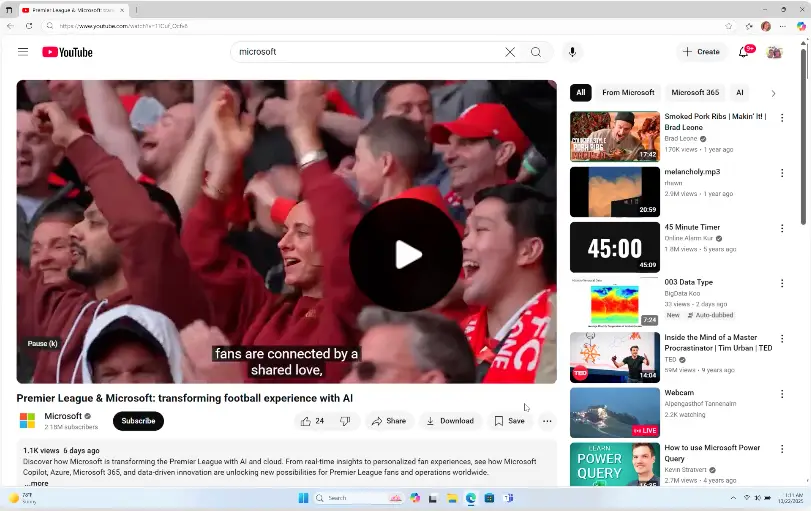
With real-time speech synchronisation in Microsoft Edge, foreign-language videos can be understood with virtually no delay. This is particularly noticeable on YouTube: spoken content is automatically recognised, translated and reproduced as synchronised speech or subtitles – directly in the browser, without additional software.
What exactly happens?
Edge combines multiple AI technologies into a continuous processing chain:
Speech recognition (speech-to-text)
The audio signal of the video is analysed in real time. Neural speech recognition converts spoken language into text, including pauses and sentence boundaries.
Machine translation
The recognised text is immediately translated into the target language. Context-based models are used for this purpose, which translate according to meaning rather than word for word.
Synchronisation with the video
The translation is precisely synchronised with the original audio. This preserves the emphasis, speaker changes and timing.
Output as subtitles or language
Depending on the settings, Edge displays the translation as live subtitles or generates synthetic speech that runs almost parallel to the original.
Application in YouTube
The benefits are particularly high for videos on YouTube:
- International tutorials become immediately understandable
- Lectures and interviews lose their language barrier
- Learning content can be consumed without prior translation
The key point: everything happens on the client side in the browser. The video itself remains unchanged; Edge simply captures the audio stream and processes it in real time.
Why the delay is so small
Edge does not work with a complete pre-transcription. Instead, the audio stream is broken down into very short segments. Each segment undergoes recognition, translation and output immediately upon receipt. This results in minimal latency of usually only a few hundred milliseconds.
Limits of technology
- Very fast or strongly accented speech can reduce accuracy.
- Technical terms are not always translated correctly.
- Emotional nuances are sometimes lost in synthetic speech output.
Nevertheless, it has great practical value, especially for informational and educational videos.
Real-time speech synchronisation in Edge is not a gimmick, but a functional tool. It breaks down language barriers in everyday life without changing workflows or requiring manual preparation of content. For international content – especially on YouTube – this is a clear productivity gain.
Your partner for IT support – Flying Supporter
Do you have any questions?
We will be happy to help you.
 Deutsch
  English (UK)
  Français
  Italiano